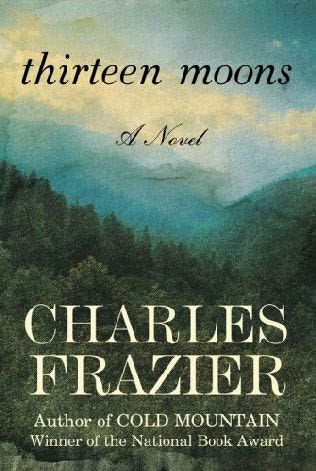
Frazier, author of other bestseller Cold Mountain, writes of a man nearing the end of his days and reflecting back on his youth in Cherokee nation in the time before the Civil War. Though white, the protagonist, Will, is sold to work at a small store amongst the natives and is taken into their tribe, growing up to become a representative for his people on Capitol Hill. His lifelong love affair with a young native woman adds romance to the tale, and the loss of said love, hinted at within the first pages, adds mystery.
What is surprising, though, is that this is not a story that paints the white man as the enemy. Yes, it highlights the flaws of the founding fathers and their followers, but it also points out the willingness of several native tribes to take part in this capitalism, selling their land and even taking on slaves in order to make a profit. Showing the good and bad of both sides with startling boldness, this book provides a wry historical account of America's youth like few other works of fiction.
Intrigued by the account of the Cherokee people, from whom I'm a partial descendant (but then again, who isn't nowadays,) I thought this book would hold my attention and provide me with some knowledge of my own people. Unfortunately, I thought wrong.
Though the first 200 pages were interesting enough, discussing the narrator's teenage years and blossoming relationship with his love, Claire, as Will ages and becomes entangled in the business of politics the plot loses steam. Perhaps other readers who have a stronger interest in government and political corruption would find this to be a more enticing read, but for me? Nah. Honestly, I gave up on this book for a few days after becoming so incredibly bored with it, but eventually decided to stick it out and trudge my way to the end.
Frazier is a decent enough writer. His characters are realistic and subtly humorous while still being powerfully severe, and his language is both simple and easy to grasp, reflecting the limited education of the characters he portrays. His weakness, though, lies in his inability to infuse a strong plot into his prose. The storyline was never truly engaging and easy to drop at any given moment. There were no elements that made me eager to turn the page and I often found myself wondering what exactly the central problem was supposed to be.
To sum up, this book was a too-long letdown of a novel. If the first part of it could be lopped off and marketed on its own, perhaps it would have been more enjoyable, but the 500 pages of confused, political prattle dragged the tale down and ruined the book for me. Unless you're particularly interested in Native American history or pre-Civil War territory exchanges, I wouldn't recommend this book as a just-for-fun read.


No comments:
Post a Comment